
Communication
Ethernet and CSMA/CD
What you need to be able to do
- 2.1Explain what Ethernet is.
- 2.1Explain how collisions are detected and avoided, including CSMA/CD (Carrier Sense Multiple Access with Collision Detection).
You need: Network topologies (collisions happen on shared media such as a bus).
Ethernet
- Data is sent in frames; each frame has the source and destination (MAC) addresses and error-checking data (so damaged frames can be detected and sent again).
- On a shared medium, Ethernet uses CSMA/CD to deal with collisions.
- An “Ethernet cable” is just a cable used to carry data using the Ethernet protocol: Ethernet itself is not a cable.
Why collisions happen
On a shared transmission medium (a bus, or devices sharing a hub) more than one computer is connected to the same medium. If two workstations start to transmit at the same time, their signals overlap: a collision. Both frames are corrupted and must be sent again.
CSMA/CD step by step
| Part of the name | Meaning |
|---|---|
| Carrier Sense | a station listens to the channel before sending: is anyone transmitting? |
| Multiple Access | many stations share the same medium |
| Collision Detection | while sending, a station checks for a collision (the signal on the line isn't what it sent) |
- A workstation with data to send listens to (monitors) the communication channel.
- If the channel is busy, it waits; when the channel is idle / free, it sends its frame.
- Two workstations can still start at the same moment (both heard silence): a collision.
- When a collision is detected, the workstations stop (abort) transmitting and send a jamming signal so every station knows.
- Each workstation waits a random amount of time (back-off) before trying again: because the times differ, they are unlikely to collide again.
- If collisions keep happening, the random wait time is increased each time (binary exponential back-off).
Avoiding collisions
Carrier sense itself avoids most collisions: nobody starts while someone else is sending. Collisions can only happen in the short moment when two stations start together. Modern wired networks avoid them almost completely by using a switch: every device has its own link, so there is no shared medium.
Drawbacks of CSMA/CD
- waiting time can keep growing as random back-offs increase (in the worst case, waiting indefinitely)
- a constant jamming signal could stop anything being sent
- certain nodes cannot be prioritised
- only suitable for short-distance networks
- not scalable: more nodes means far more collisions and longer waits
Dry run: CSMA/CD slot by slot
Run the protocol yourself. Time is split into slots. For each slot, decide what each station does and what is on the cable, then check the row: the bus drawing shows the slot once you have it right. Rules: a station with a frame listens; it sends only if nobody is already sending or jamming; two starting together collide; next slot they jam; then each backs off for its own number of slots and listens again. “New scenario” gives a fresh run.
CSMA/CD dry run
The completed dry run for this scenario (A and B ready in slot 1, 2 slots each; C ready in slot 3, 1 slot; back-offs A 2, B 1):
| Slot | A | B | C | Channel |
|---|---|---|---|---|
| 1 | Send | Send | — | Collision |
| 2 | Jam | Jam | — | Jam signal |
| 3 | Back-off | Back-off | Send | Busy |
| 4 | Back-off | Send | — | Busy |
| 5 | Wait | Send | — | Busy |
| 6 | Send | — | — | Busy |
| 7 | Send | — | — | Busy |
What the run shows: the collision in slot 1 costs three slots (collision, jam, back-off) before any frame gets through; C slips in during the back-off; A has to wait in slot 5 because B is sending (carrier sense working). That lost time is why CSMA/CD performs badly on a busy shared cable.
Mark-scheme focus
Describe what is meant by Ethernet (3 marks)
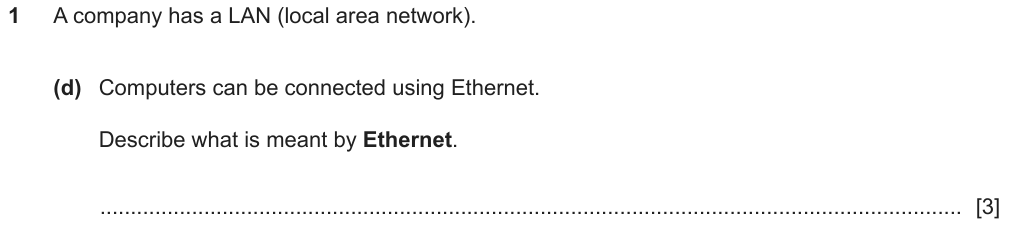
- A protocol (suite) B1
- for data transmission over standard / universal wired network connections B1
- Uses CSMA/CD // data transmitted in frames … each frame has a source and destination (IP / MAC) address … and error-checking data B1
- “Ethernet is a cable”
- “Ethernet is a type of internet”
From: 9618/12/M/J/23 Q1(d)
Describe CSMA/CD (4 marks)

- A workstation listens to the communication channel … data is only sent when the channel is free B1 B1
- Because more than one computer is connected to the same medium, two can start to transmit at the same time, causing a collision B1
- If a collision happens, the workstations send a jamming signal / abort … and each waits a random time before resending B1
- “CSMA/CD checks the line / sends a jam signal” (the protocol doesn't act)
- Missing the random wait
Every action belongs to a workstation; the random wait is what stops the same two colliding again.
From: 9618/12/M/J/22 Q9(c)
- CSMA/CD in about every other paper: describe it (3-4), or describe what happens after a collision (2), or name tasks (3), sometimes with drawbacks (2).
- Ethernet: a protocol, frames, addresses, error checking, CSMA/CD.
Worked examples
Example 1 · CSMA/CD on a bus (Paper 1, 4 marks) ★ Easy

Tell the story in order: listen, send if free, why collisions still happen on a bus, what happens after one.
- bus topologyone shared cable
- describe how … is usedthe actions, in order, by the devices
- WholeCSMA/CD on a bus
- Story
- 1check channel busy?
- 2wait or send
- 3collision: abort / jam
- 4random wait, retry
5 Now solve it have a go on paper first, then open the worked solution
- CSMA/CD is a protocol used to detect and deal with collisions in a bus B1
- Before transmitting, a device checks if the channel is busy; if busy it waits, if free the data is sent B1
- Two workstations can start at the same time on the shared medium, causing a collision; if a collision is detected, transmission is aborted / a jamming signal is sent B1
- Both devices wait a (different) random time and then try again B1
Every action has a device doing it ✓. The report: “packets”, not “packages”.
Example 2 · Managing a collision; two drawbacks (Paper 1, 4 marks) ★★ Medium
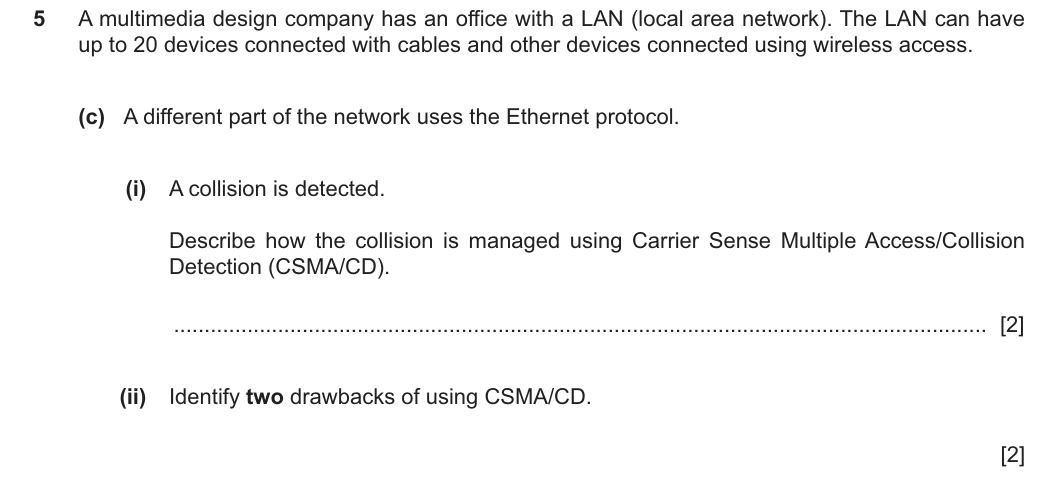
(i) starts AFTER the collision is detected: no marks for listening first. (ii) two weaknesses of the method.
- a collision is detectedbegin from the detection
- drawbacksproblems with the method itself
- (c)(i)after the collision
- (c)(ii)two drawbacks
5 Now solve it have a go on paper first, then open the worked solution
- (i) A jamming signal is transmitted by the sending device / transmission aborted B1; the device waits a random time before trying again … the wait increases with further collisions B1
- (ii) Random time increases each time, so waiting can become very long / infinite B1; nodes can't be prioritised // limited distance // not scalable // possible constant jamming B1
(i) contains nothing from before the collision ✓.
Example 3 · Three tasks devices perform (Paper 1, 3 marks) ★ Easy
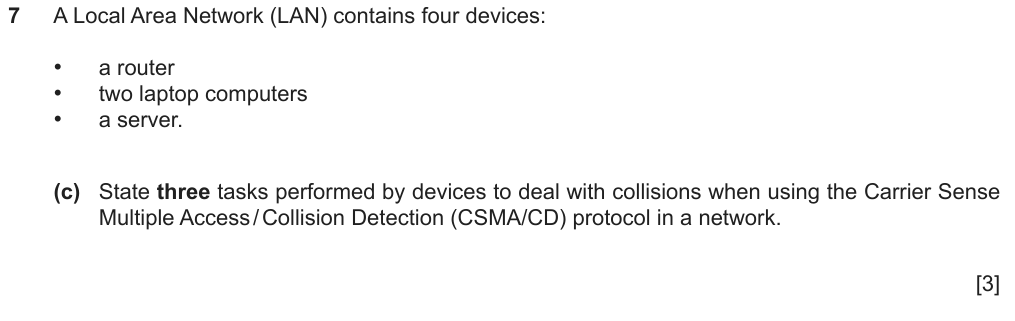
“Tasks performed by devices”: verbs the workstation does.
- (c)three tasks
5 Now solve it have a go on paper first, then open the worked solution
- Monitor the communications channel and send only when it is idle B1
- Detect a collision and stop transmitting / send a jamming signal B1
- Calculate a random back-off time, then retransmit (increasing it after repeated collisions) B1
Each is a task, done by the device ✓.
Summary
- Ethernet: a protocol for wired LAN transmission; frames with source / destination MAC addresses and error checking; uses CSMA/CD.
- CSMA/CD: listen; send when idle; detect collision; stop + jam; random back-off (growing); retry.
- Switches avoid collisions by giving each device its own link.
| If you see… | do this |
|---|---|
| “describe Ethernet” | protocol + wired + frames / addresses / error check / CSMA/CD |
| “describe CSMA/CD” | workstations listen → send if idle → collision → jam → random wait |
| “a collision is detected …” | start from the jam signal |
Can I do this?
- I can describe Ethernet as a protocol, with frames and addresses.
- I can explain why collisions happen on a shared medium.
- I can describe CSMA/CD in order, with the workstations doing the actions.
- I can dry-run CSMA/CD slot by slot.
- I can give drawbacks of CSMA/CD and how collisions are avoided.
Anything unticked: revise that section first. All ticked: take the quiz.
Quiz
The multiple-choice and guided questions need JavaScript. The concept checks and exam practice below work without it.
Concept checks
Answer each one in your head first, then open it.
1If every station listens first, how can two still collide?Show answer
A signal takes time to travel along the cable: two stations can both hear silence and start within that tiny gap, before either signal reaches the other.
2Why does the back-off time get longer after repeated collisions?Show answer
Repeated collisions mean the network is busy; spreading the retries over a longer time makes another clash less likely.
3Does CSMA/CD matter on a full-duplex switched network?Show answer
Hardly: each device has its own link and can send and receive at once, so collisions don't occur.
Exam-style practice
New questions, not used above. Do them on paper, then mark your work against the official mark scheme.
A small office uses a bus network running Ethernet.
- (a)Explain why collisions can occur on this network.[2]
- (b)The office replaces the bus with a star topology using a switch. Explain why this reduces collisions.[2]
Show the mark scheme
| Part | Answer / working | Marks | Guidance |
|---|---|---|---|
| (a) | All devices share the same transmission medium / one cable | B1 | |
| Two devices can start transmitting at the same time (both hearing an idle line) | B1 | ||
| (b) | Each device has its own link to the switch // no shared medium | B1 | |
| The switch forwards each packet only to its destination, so devices are not competing for one cable | B1 | ||
| Total: 4 marks | |||
Stations P and Q on an Ethernet bus both start sending in the same time slot.
Describe what P does from the moment the collision happens until its frame is successfully sent.
- [3]
Show the mark scheme
| Part | Answer / working | Marks | Guidance |
|---|---|---|---|
| P detects the collision, stops transmitting and sends a jamming signal | B1 | ||
| P waits a random back-off time (different from Q's) | B1 | ||
| P listens again and resends when the channel is idle (backing off for longer if it collides again) | B1 | ||
| Total: 3 marks | |||
Your progress on this note is saved when JavaScript is on.