
Communication
Transmission media: wired and wireless
What you need to be able to do
- 2.1Describe the characteristics of copper cable, fibre-optic cable, radio waves (including WiFi), microwaves and satellites.
- 2.1Explain the differences between wired and wireless networks and the implications of using each.
You need: Networks: LAN and WAN. Next: LAN hardware and routers.
Transmission media
Data travels as a signal through a medium: electrical pulses in metal, pulses of light in glass, or electromagnetic waves through the air or space. The key words for comparing them: bandwidth (how much data per second), interference (noise that corrupts signals), distance before the signal fades (needing a repeater), security (how easily it is tapped), cost and latency (delay).
| Medium | How data travels | Characteristics |
|---|---|---|
| Copper cable (twisted pair, coaxial) | electrical signals | cheap, easy to install and join; lower bandwidth than fibre; affected by electrical interference; signal fades over long distances (repeaters needed); can be tapped |
| Fibre-optic cable | pulses of light along glass fibres | very high bandwidth / transmission rate; immune to electrical interference; much longer distances before repeaters; hard to tap / hack; more expensive, harder to join, glass fibres more fragile |
| Radio waves (Wi-Fi, Bluetooth) | electromagnetic waves on different frequencies, broadcast in all directions | no cables, mobility; pass through walls (weakened); short range for Wi-Fi; interference from other devices; can be intercepted (needs encryption) |
| Microwaves | higher-frequency electromagnetic waves, beamed point to point between dishes / towers | line of sight needed (towers on hills / tall buildings); high bandwidth; affected by weather / obstacles; used to link towers in mobile networks and across terrain where cables are hard |
| Satellites | microwaves to and from a satellite in orbit, relayed back to Earth | cover remote / rural areas and moving users (ships, planes); not fixed to a single location; high latency (long distance to orbit, especially geostationary); affected by bad weather; expensive equipment; needs a clear view of the sky |
Fibre vs copper
| Fibre-optic | Copper |
|---|---|
| data transmitted using light | data transmitted using electrical signals |
| higher bandwidth / transmission rate | lower bandwidth |
| smaller risk of interference (noise) | affected by electromagnetic interference |
| longer distances before repeaters are needed | repeaters needed sooner |
| much more difficult to hack into | easier to tap |
| more prone to damage (fragile), more expensive | robust and cheaper |
Wired or wireless?
| Wired (cable) | Wireless (Wi-Fi) | |
|---|---|---|
| Speed | faster / higher bandwidth, lower latency | transmission speed can be slower, shared between users |
| Reliability | more reliable / stable: less affected by distance, walls, interference | interference from walls, other devices; signal degrades quickly with distance (needs repeaters / boosters) |
| Security | more secure: someone must physically connect | less secure: signals can be picked up by anyone in range (must be encrypted) |
| Mobility | fixed position | devices can be mobile: no physical connection |
| Set-up / expansion | cabling costs and installation; adding a device needs a cable and a port | no cabling: easier / cheaper to set up; easier to add devices; many different device types (phones, tablets) can join |
1 Streaming and gaming
Melinda mainly watches films and plays games online. Wired or wireless? Justify.
Askedchoice + reasonsKnowbig downloads, low delay wantedRoutespeed, stability
- Wired (no mark for the choice)
- faster connection / higher bandwidth … needed for downloading / streaming large files
- more reliable / stable, less latency, so fewer delays in games
Wireless can also be justified: freedom to move between rooms, easy for friends to join, cheaper set-up. The marks are in the reasons.
2 A hospital ward
Nurses carry tablets around a ward to update patient records. Which, and why?
Askedchoice + reasonsKnowmoving staffRoutemobility
- Wireless: nurses move around with the tablets; no cables to trip over
- data must be encrypted because wireless signals can be intercepted
3 Linking two buildings 2 km apart
A company links two sites 2 km apart. Copper or fibre?
Askedmedium + reasonsKnowlong distance, high trafficRoutedistance + bandwidth
- Fibre-optic: longer distances before repeaters are needed
- higher bandwidth for all the traffic between the sites; not affected by electrical interference
4 A remote research station
Scientists in a remote desert camp need internet access. Which medium?
Askedmedium + reasonsKnowno cables or towers nearbyRoutesatellite
- Satellite: works in remote areas with no cable or mobile infrastructure
- drawbacks: high latency, affected by bad weather, expensive equipment
Mark-scheme focus
Three differences between fibre-optic and copper cables (3 marks)

- Fibre uses light, copper uses electrical signals B1
- Fibre has higher bandwidth / transmission rates B1
- Fibre has a smaller risk of (noise) interference // longer distances before repeaters // much more difficult to hack // fibre more prone to damage B1
- “Fibre is better” (not a difference)
- More than three answers (only the first three are marked)
Each difference names a property and says which cable has more of it.
From: 9618/12/M/J/22 Q9(b)
Wired or wireless for films and games? Justify (3 marks)
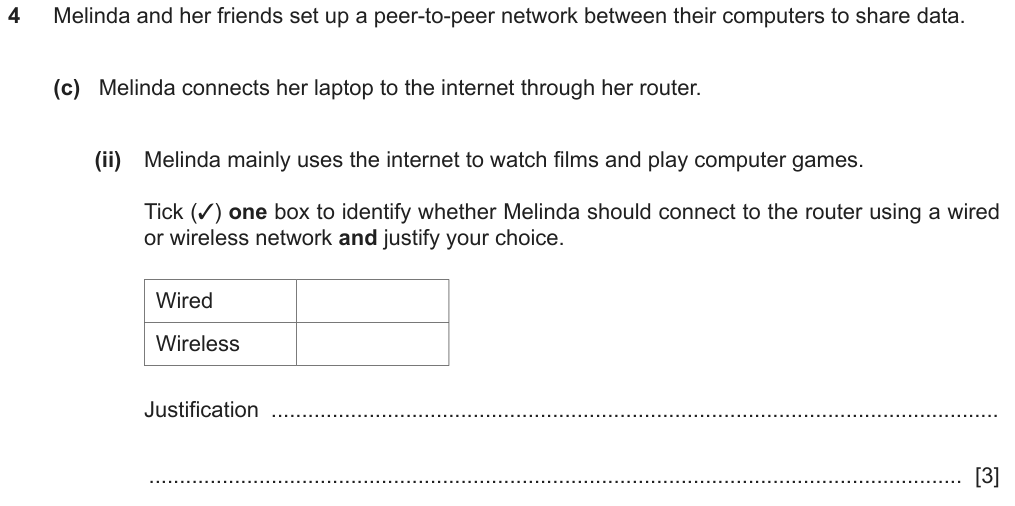
- No mark for the tick. Wired: faster connection / higher bandwidth B1 … needed as she is streaming / downloading large files B1; more reliable / stable // less latency // more secure B1
- Wireless: freedom of movement between rooms B1 … no physical connection needed; easily expanded if friends join B1; less cabling, cheaper set-up B1
- “More convenient” with no reason
- A justification that doesn't fit the tick
From: 9618/11/M/J/21 Q4(c)(ii)
- Media: identify and describe two (4 marks), fibre vs copper (3), satellite advantage / disadvantages (3).
- Wired vs wireless: advantages / drawbacks (1-4), or justify a choice in context (3).
Worked examples
Example 1 · Two other media for a WAN (Paper 1, 4 marks) ★ Easy
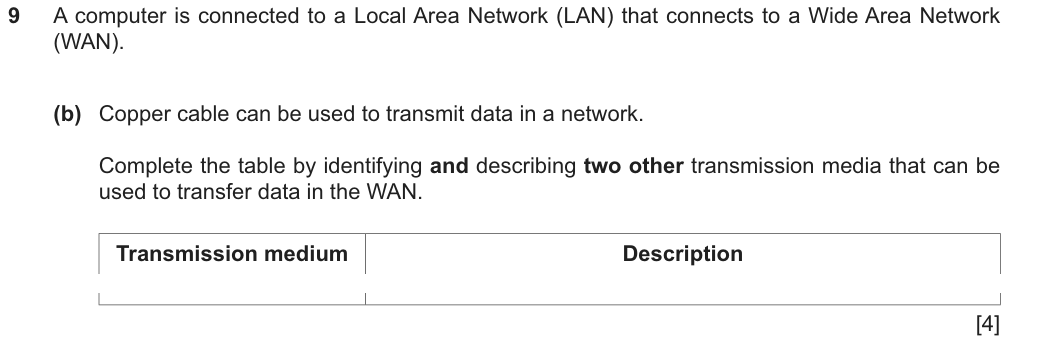
“Two other”: not copper. Each row: name (1) + how it carries data or a key characteristic (1).
- two othercopper is excluded
- describinghow the medium carries data
- (b)2 media + descriptions
5 Now solve it have a go on paper first, then open the worked solution
- Fibre optic B1: transmits data as pulses of light B1
- Radio waves / microwaves B1: transmit electromagnetic waves on different frequencies B1
Satellite with a matching description would also score ✓.
Example 2 · Satellites instead of copper cables (Paper 1, 3 marks) ★★ Medium
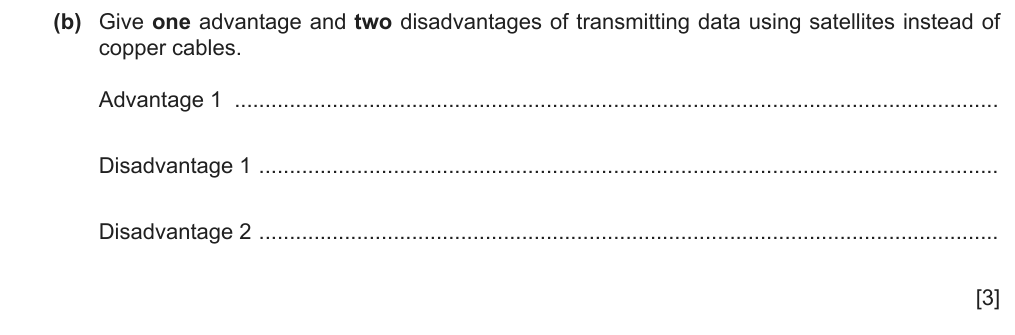
Compared with copper cables: where can a satellite reach that a cable can't? What does the trip to orbit cost?
- instead of copperthe comparison is with a fixed cable
- (b)1 advantage + 2 disadvantages
5 Now solve it have a go on paper first, then open the worked solution
- Advantage: not fixed to a single location // allows access in remote / rural areas B1
- Disadvantages: high latency / lag B1; signal affected by bad weather // more expensive equipment // slower than fixed-line broadband // direct line of sight needed B1
The report: the most popular disadvantage was interference (weather).
Example 3 · Why offer students both wired and wireless? (Paper 1, 4 marks) ★★ Medium
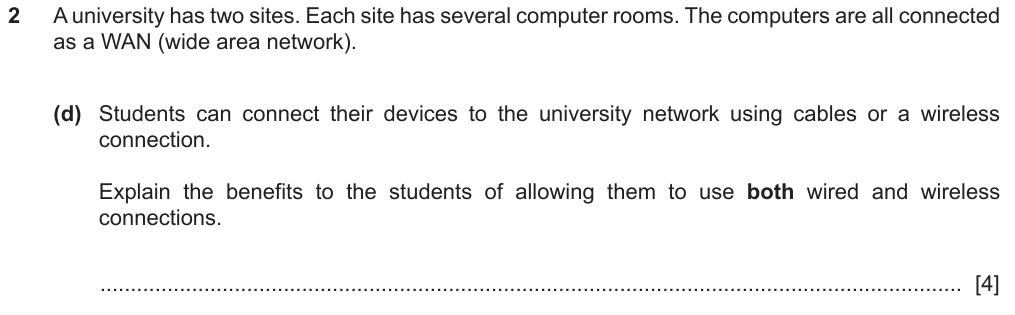
Benefits to the students of having both: what each option gives them that the other doesn't.
- bothbenefits of wired + benefits of wireless + choice itself
- to the studentstheir work, their devices
- (d)4 benefits
5 Now solve it have a go on paper first, then open the worked solution
- Some students might only have one sort of connection on their device B1
- Wired provides better performance … e.g. faster access to university databases; less interference; confidential work sent securely B1 B1
- Wireless lets students use their devices in different rooms / anywhere, bring several devices B1
Each point is about what the student can do ✓.
Summary
- Copper: electrical, cheap, interference, shorter range. Fibre: light, high bandwidth, no interference, long range, hard to tap, fragile, costly.
- Radio (Wi-Fi): no cables, mobility, interference, less secure. Microwaves: line of sight between towers. Satellite: remote areas, high latency, weather.
- Wired: faster, stable, secure, fixed. Wireless: mobile, easy to set up / expand, slower, less secure, interference.
| If you see… | do this |
|---|---|
| “describe a medium” | name + how it carries data / a real characteristic |
| “wired or wireless? justify” | no mark for the choice: reasons tied to the user's activity |
| “satellite vs cable” | + remote areas / not fixed; − latency, weather, cost, line of sight |
Can I do this?
- I can describe copper, fibre, radio, microwave and satellite transmission.
- I can give three differences between fibre and copper.
- I can compare wired and wireless networks.
- I can justify wired or wireless (or a medium) for a given use.
Anything unticked: revise that section first. All ticked: take the quiz.
Quiz
The multiple-choice and guided questions need JavaScript. The concept checks and exam practice below work without it.
Concept checks
Answer each one in your head first, then open it.
1Why does a wireless signal get weaker further from the access point?Show answer
The waves spread out in all directions, so their energy is shared over a bigger area; walls and other objects absorb some too.
2Why can't fibre be affected by electrical interference?Show answer
It carries light in glass, not electric current, so nearby electrical equipment can't induce noise in it.
3Why does a geostationary satellite add a delay you can notice in a video call?Show answer
The signal goes up about 36 000 km and back down - roughly a quarter of a second each way.
Exam-style practice
New questions, not used above. Do them on paper, then mark your work against the official mark scheme.
A village with no cable broadband is choosing between a satellite link and a microwave link to a town 15 km away.
- (a)Describe how data is transmitted by a microwave link.[2]
- (b)Give two drawbacks of using a satellite link.[2]
Show the mark scheme
| Part | Answer / working | Marks | Guidance |
|---|---|---|---|
| (a) | Electromagnetic (microwave) signals beamed point to point between dishes / towers | B1 | |
| A clear line of sight is needed between them | B1 | ||
| (b) | High latency / lag | B1 | |
| Affected by bad weather // expensive equipment // slower than fixed-line broadband // line of sight to the sky needed | B1 | ||
| Total: 4 marks | |||
A school is replacing the copper cable between its server room and a building 400 m away with fibre-optic cable.
Describe three benefits of using fibre-optic cable for this link.
- [3]
Show the mark scheme
| Part | Answer / working | Marks | Guidance |
|---|---|---|---|
| Higher bandwidth / transmission rate | B1 | ||
| Longer distance before repeaters are needed | B1 | ||
| Not affected by electrical interference // much harder to tap / hack | B1 | ||
| Total: 3 marks | |||
Your progress on this note is saved when JavaScript is on.