
Practical skills: Paper 6 Alternative to Practical
Measurements and readings: scales, precision, zero error and parallax
In this note
- AO3Read any scale: work out what one division is worth, read to the nearest half-division on an analogue scale, take a digital display as shown.
- AO3Record every reading to the precision of the instrument, with its unit.
- AO3Correct for a zero error; avoid parallax (eye perpendicular to the scale).
- AO3Use the standard techniques that make a measurement accurate: many at once, set squares, blocks, a fiducial marker, stirring, waiting.
- AO3Measure lengths on a scale drawing and convert them to real lengths.
Before you start: the ATP paper.
Rules to learn
Reading any scale
Every instrument in the paper is drawn, and the first marks are for reading it. The method is always the same.
General methodHow to read any analogue scale
- Find two labelled marks next to each other (e.g. 20 and 30).
- Count the divisions (spaces, not lines) between them (e.g. 10).
- One division = difference ÷ number of divisions (10 ÷ 10 = 1 °C).
- Count divisions up from the labelled mark below the pointer.
- If the pointer is between two marks, read to the nearest half-division (23.5 °C).
- Write the unit if the answer line has none.
Example Read the ammeter.
Labelled marks 0.2 and 0.4 are 4 divisions apart, so one division = 0.05 A.
- 0.2 A is the labelled mark below the needle.
- The needle is 3 divisions above it: 0.2 + 3 × 0.05 = 0.35 A.
Answer 0.35 A
A digital display is read exactly as shown, with its unit. A stopwatch showing 00:13.58 (minutes : seconds) is 13.58 s; 01:05.32 is 60 + 5.32 = 65.32 s. If told "to one decimal place", 13.58 s becomes 13.6 s.
Try it yourself
Show answer
Answer 57 °C
Show answer
Answer 72.40 s
Show answer
Answer 2.4 V
Instruments and their precision
Record a reading to the precision the instrument gives - no more, no less. A ruler in millimetres gives lengths to the nearest 0.1 cm, so 5.6 cm, never 5.60 cm (more precise than a ruler can be) and never 6 cm (throws a millimetre away).
| Instrument | Smallest division (school lab) | Record to | Example |
|---|---|---|---|
| Ruler / metre rule | 1 mm | 0.1 cm (nearest mm) | 12.4 cm |
| Protractor | 1° | 1° (or 0.5°) | 48° |
| Thermometer | 1 °C | 0.5 °C | 23.5 °C |
| Measuring cylinder (100 cm³) | 1 cm³ | 0.5 cm³ or 1 cm³ | 72 cm³ |
| Stopwatch (digital) | 0.01 s | as shown, or the d.p. asked for | 13.58 s → 13.6 s |
| Top-pan balance | 0.1 g | as shown | 114.1 g |
| Force meter (newton meter) | 0.1 N | 0.1 N (0.05 N) | 2.6 N |
| Ammeter / voltmeter (analogue) | e.g. 0.05 A, 0.1 V | half a division | 0.35 A |
Zero errors
An instrument has a zero error if it does not read zero when it should (nothing on the force meter, nothing on the balance, the ruler's end worn away). Every reading is then off by the same amount, so it is a systematic error: repeating does not remove it. Correct it by subtracting the zero reading.
Example A force meter reads 0.2 N with no load. With a stone on it, it reads 2.8 N. What is the weight of the stone?
Subtract the zero reading.
- 2.8 − 0.2 = 2.6 N
Answer 2.6 N
A negative zero error (the pointer sits below zero, say −0.1 N) is added back: a reading of 1.5 N is really 1.5 − (−0.1) = 1.6 N. On a ruler whose end is damaged, measure from the 1.0 cm mark and subtract 1.0 cm.
Try it yourself
Show answer
Answer 7.2 g
Show answer
Answer 12.7 cm
Parallax: where to put your eye
A parallax error is a wrong reading caused by looking at a scale from an angle: the pointer (or the liquid level, or the end of the spring) lines up with a different mark depending on where your eye is. Avoid it by putting your eye level with the reading so your line of sight is perpendicular (at 90°) to the scale.
| Instrument | How to avoid parallax |
|---|---|
| Thermometer | eye level with the top of the liquid thread, line of sight perpendicular to the scale |
| Measuring cylinder | eye level with the bottom of the meniscus, cylinder on a flat bench |
| Ruler beside a spring or pendulum | ruler held close to (touching) the object; eye perpendicular to the scale; a set square to carry the level across |
| Meter with a needle | look straight at the needle (some meters have a mirror strip: line the needle up with its reflection) |
Techniques that make a measurement accurate
Many questions ask "Suggest a technique to make this measurement accurate". The answer is always a specific action for that instrument. These are the ones Cambridge rewards again and again.
| Problem | Technique | Why it helps |
|---|---|---|
| Too small to measure once (thickness of paper, diameter of thin wire) | measure many together (100 sheets; 20 turns of wire round a pencil), then divide | the ruler's ±1 mm is shared over many, so the percentage error is smaller |
| Too quick to time once (one swing, one oscillation) | time 20 oscillations and divide by 20 | reaction time is a fixed error; shared over 20 swings its effect is much smaller |
| Hard to see where a swing starts and stops | use a fiducial marker at the centre of the swing; start counting from zero as it passes | the bob moves fastest at the centre, so the moment it passes is clearest |
| Ruler must be vertical / height must be level | use a set square against the bench (or a plumb line); a set square to carry the level of the bob to the ruler | removes slanted readings |
| Diameter of a ball or cylinder | two blocks (or set squares) touching it on each side; measure the gap; average two places | you measure between flat faces, not to a curved edge |
| Temperature of water | stir before reading; wait until the reading stops rising | even temperature throughout; the thermometer needs time to reach the water's temperature |
| Any reading | repeat and take the average | reduces the effect of random errors |
Example 100 sheets of paper make a stack 0.9 cm thick. What is the thickness of one sheet?
Many at once: divide by the number.
- \(0.9\div100=0.009\) cm
Answer 0.009 cm (0.09 mm)
Try it yourself
Show answer
Answer 0.063 cm
Show answer
Answer 1.58 s
Measuring on a diagram drawn to scale
Some figures say "drawn one-quarter full size" or "scale 1 : 5". Measure on the page with your ruler, then multiply by the scale factor to get the real size. If the figure is full size, the measurement is the answer.
Example A spring in a diagram drawn one-quarter full size measures 4.2 cm. What is the real length?
Quarter size means the real thing is 4 times bigger.
- 4.2 × 4 = 16.8 cm
Answer 16.8 cm
Try it yourself
Show answer
Answer 0.18 m
From the past papers
Past paper 1
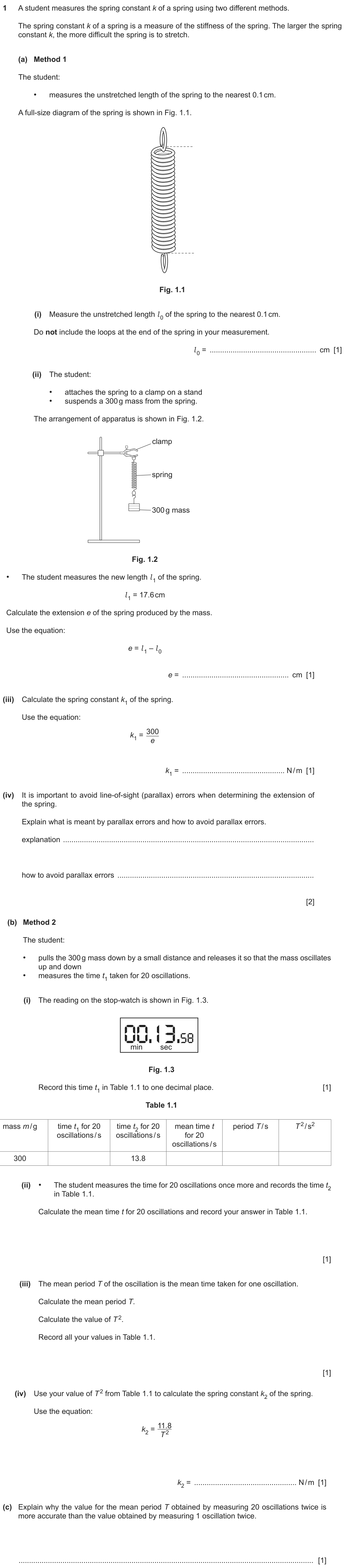
How to start: Fig. 1.1 is full size, so l₀ is your ruler measurement between the dashed lines (5.5 cm on the paper). The stopwatch reads 00:13.58: that is 13.58 seconds, to be recorded to one decimal place.
✓ Show the answer have a go on paper first
- (a)(i) \(l_0=5.5\) cm (full size, nearest 0.1 cm, loops left out).
- (a)(ii) \(e=l_1-l_0=17.6-5.5=12.1\) cm.
- (a)(iii) \(k_1=\dfrac{300}{12.1}=24.8\) N/m.
- (a)(iv) Parallax: the reading changes with the position of the eye, because the eye is not level with / perpendicular to the scale. Avoid it: view the scale with the eye level with the end of the spring, perpendicular to the ruler.
- (b)(i) 13.58 s to 1 d.p. → \(t_1=13.6\) s.
- (b)(ii) mean \(t=\dfrac{13.6+13.8}{2}=13.7\) s.
- (b)(iii) \(T=13.7\div20=0.685\) s (0.68 or 0.69); \(T^2=0.469\) s².
- (b)(iv) \(k_2=\dfrac{11.8}{0.469}=25.1\) N/m (anything from 23.6 to 25.7 accepted, depending on your rounding).
- (c) The reaction-time error at the start and stop is the same whether you time 1 or 20 oscillations, so over 20 it is a much smaller fraction of the time: timing 20 reduces the effect of reaction-time errors (the percentage uncertainty).
| Part | Answer / working | Marks | Guidance |
|---|---|---|---|
| (a)(i) | 5.5 (cm) | B1 | |
| (a)(ii) | 12.1 (cm) | B1 | |
| (a)(iii) | 24.8 (N/m) or 300 / candidate's (ii) | B1 | |
| (a)(iv) | description of parallax error | B1 | |
| perpendicular viewing / view at eye level | B1 | ||
| (b)(i) | 13.6 (s) | B1 | |
| (b)(ii) | 13.7 (s) | B1 | |
| (b)(iii) | T = 0.68 / 0.685 / 0.69 / 0.7 (s) and T² = 0.46 to 0.5 (s²) | B1 | |
| (b)(iv) | 23.6 to 25.7 (N/m) inclusive | B1 | |
| (c) | reduces the effect of (reaction) timing errors / reduces the percentage uncertainty / the error is spread over 20 oscillations | B1 | "reduces the reaction time error" is not enough |
| Total: 10 marks | |||
Examiner tip The report: many divided by 10 instead of 20, doubled T instead of squaring it, or recorded 13.58 when asked for one decimal place.
Explaining why 20 oscillations are timed
Explain why the value for the mean period T obtained by measuring 20 oscillations twice is more accurate than the value obtained by measuring 1 oscillation twice.
- timing 20 oscillations reduces the effect of reaction-time errors
- the reaction-time error is spread over 20 oscillations
- it reduces the percentage uncertainty in T
- "it reduces human reaction time error"
- "it is more accurate"
- "you can take an average"
Your reaction time is the same (about 0.2 s) however many swings you time, so the error itself does not shrink. What shrinks is its size compared with the time measured. The report singled this out: almost everyone who mentioned reaction time said it was reduced.
From: 5054/42/O/N/23 Q1(c) scheme and report; same idea in 0625/61/O/N/24 Q1(d)
Type 1 Read a scale
"Record the temperature θ shown on the thermometer." (1 mark)
Spot it a drawn scale or display.
- Value of one division.
- Count from the labelled mark below.
- Nearest half-division; unit.
Type 2 Measure on the figure
"On Fig. 1.1, measure the length… to the nearest 0.1 cm" (1 mark)
Spot it "On Fig. …, measure".
- Ruler on the paper, zero at one end.
- Nearest mm, written in cm (5.5 cm).
- Scale factor if the figure is not full size.
Type 3 Technique for accuracy
"Suggest one technique to ensure the length is measured accurately." (1 mark)
Spot it "technique", "precaution".
- Name the action AND the instrument: "set square to check the ruler is vertical".
Type 4 Parallax
"Explain what is meant by parallax errors and how to avoid them." (2 marks)
Spot it "parallax", "line of sight".
- Explain: reading depends on where the eye is.
- Avoid: eye level with the reading, perpendicular to the scale.
Mistakes to avoid
- ✗ 5.60 cm from a mm ruler✓ 5.6 cmA ruler cannot measure hundredths of a centimetre (0625/62/M/J/24 report).
- ✗ w = 3 cm✓ 3.0 cmLengths to the nearest mm need the .0 (0625/63/M/J/24 report).
- ✗ eye parallel to the scale✓ eye perpendicular to the scale, level with the reading
- ✗ "to avoid parallax error" on its own✓ say where the eye goes for THIS instrumentRote phrases score nothing.
- ✗ dividing by 4 for a quarter-size figure✓ multiply by 4
- ✗ 13.58 recorded "to one decimal place"✓ 13.6 sRead the instruction.
Summary
- One division = difference between labels ÷ number of divisions; read analogue scales to the nearest half-division.
- Record to the instrument's precision: rulers to 0.1 cm, thermometers to 0.5 °C, displays as shown.
- Zero error: subtract the zero reading from every reading.
- Parallax: eye level with the reading, line of sight perpendicular to the scale.
- Too small or too quick: measure many at once and divide.
If you see …
- "drawn one-quarter full size"measure, then × 4.
- "technique"action + instrument + why.
- a stopwatch in min:sconvert minutes to seconds.
Practice
Practice: easy, medium, hard
Easy
Show answer
Answer 2 cm³
Show answer
Answer 3.3 N
Show answer
Answer 7.0 cm
Medium
Guide me
What is it asking? one diameter
What do we know? 25 diameters = 1.0 cm
Plan divide, then cm → mm
Show working
- \(1.0\div25=0.040\) cm
- = 0.40 mm
Answer 0.40 mm
Guide me
What is it asking? T and T²
What do we know? 20 swings
Plan divide by 20, then square
Show working
- \(26.8\div20=1.34\) s
- \(1.34^2=1.7956\to1.80\) s²
Answer T = 1.34 s, T² = 1.80 s²
Guide me
What is it asking? a technique
What do we know? a right angle to the bench
Plan set square
Show answer
Answer stand a set square on the bench against the rule (or use a plumb line)
Hard
Show working
- 6.3 × 5 = 31.5 cm
Answer 31.5 cm
| Part | Answer / working | Marks | Guidance |
|---|---|---|---|
| × 5 | M1 | ||
| 31.5 cm | A1 | ||
| Total: 2 marks | |||
Show answer
Answer stir: the water is the same temperature throughout; wait: the thermometer needs time to reach the water's temperature (reading stops changing)
| Part | Answer / working | Marks | Guidance |
|---|---|---|---|
| stirring gives an even temperature throughout the water | B1 | ||
| waiting lets the thermometer reach the temperature of the water / the reading stops rising | B1 | ||
| Total: 2 marks | |||
Show working
- true = reading − zero reading = 0.80 − (−0.05)
Answer 0.85 A
| Part | Answer / working | Marks | Guidance |
|---|---|---|---|
| 0.80 − (−0.05) | M1 | ||
| 0.85 A | A1 | ||
| Total: 2 marks | |||
Can I do this?
- I can find the value of one division and read any scale to the nearest half-division.
- I record each instrument to its precision (5.6 cm, 23.5 °C, 13.58 s).
- I can correct readings for a zero error.
- I can explain parallax and say where to put my eye for each instrument.
- I can suggest the right technique: many at once, fiducial marker, set square, blocks, stir and wait.
- I can measure on a scale drawing and convert to the real length.
Anything unticked: revise that section first. All ticked: take the quiz.
Quiz
The multiple-choice and guided questions need JavaScript. The concept checks and exam practice below work without it.
Your progress on this note is saved when JavaScript is on.