
Practical skills: Paper 6 Alternative to Practical
The Alternative to Practical paper: how it works and how to score
In this note
- AO3Know how Paper 6 is built, question by question, and what earns its 40 marks.
- AO3Use the words of measurement correctly: accurate, precise, repeatable, reproducible, valid, anomaly, range.
- AO3Answer each command word the way the mark scheme expects: record, calculate, suggest, explain, justify, plan.
- AO3Plan your hour so the graph and the planning question get the time they need.
This is the first note of the practical-skills chapter. Each skill has its own note after this one.
Rules to learn
How the paper is built
You do not do an experiment in this paper. Each question describes one that a student did, with diagrams of the apparatus and the readings. You read the instruments in the diagrams, finish the table, calculate, draw a graph, decide what the results show and say how the experiment could be better. The last question is a plan: you describe an experiment you have not seen.
| Question | Marks | Usually |
|---|---|---|
| 1 | 11 | mechanics: balancing, spring, pendulum or density |
| 2 | 11 | thermal: cooling or heating water |
| 3 | 11 | electricity or optics (one of them, the other often in Q1/Q2) |
| 4 | 7 | plan an investigation |
Total 40 marks in 1 hour (IGCSE 0625, Paper 6).
Whatever the experiment, the same jobs come up in every paper:
| Job | How often | Taught in |
|---|---|---|
| Read a scale or a diagram (ruler, thermometer, meter, protractor, stopwatch) | every question | Measurements and readings |
| Finish a table: headings with units, same number of decimal places | every paper | Tables and calculations |
| Calculate a result to 2 or 3 significant figures, with its unit | every question | Tables and calculations |
| Plot a graph, draw the best-fit line, find a gradient or intercept | every paper (4 or more marks) | Graphs |
| Say whether the results support a claim (within 10%?) | almost every paper | Conclusions and evaluation |
| Suggest a precaution, a source of error or an improvement | every question | Conclusions and evaluation |
| Plan an investigation | every paper (last question) | Variables and planning |
Quick check
Show answer
Answer 7
The language of measurement
Cambridge uses these words exactly. You do not have to recite definitions, but questions use them ("Suggest how the student could check that the result is reproducible"), so you must know what each one asks for.
| Word | Means | Example (our own numbers) |
|---|---|---|
| true value | the value an ideal measurement would give | the real length of the rod, 25.0 cm |
| accurate | close to the true value | 24.9 cm for a 25.0 cm rod is accurate |
| precise | repeated readings are close to EACH OTHER | 26.1, 26.2, 26.1 cm: precise, but not accurate if the rod is 25.0 cm |
| repeatable | same result when YOU repeat it the same way | you time 20 swings twice: 31.2 s and 31.4 s |
| reproducible | same result by a different method, person or set of apparatus | a friend gets 31.3 s with another stopwatch; or you repeat the ray at 60° on the other side of the normal |
| valid | the experiment tests what it claims: a fair test, only the IV and DV change | both beakers start at 80 °C when you compare lids |
| anomaly | a result outside the pattern of the others | 12.0, 12.2, 15.6, 12.1 s - the 15.6 s |
| range | lowest to highest value of a variable | lengths from 10 cm to 90 cm |
| independent variable | the one YOU change | length of wire |
| dependent variable | the one you measure | current in the wire |
Try it yourself
Show answer
Answer precise, not accurate
Show answer
Answer reproducible
Show answer
Answer 12.6 s
Command words: what each one wants
| Command | What you write | Example answer (our own) |
|---|---|---|
| Record / write down | the reading, to the precision of the scale, with its unit if the line has none | 23.5 °C (thermometer in 1 °C steps, read to the half) |
| Calculate | the working, then the answer to 2 or 3 s.f., with the unit | \(R=\dfrac{1.8}{0.24}=7.5\ \Omega\) |
| State | one short fact, no reason | the image is inverted |
| Explain | the reason, linked to THIS experiment | timing 20 swings reduces the effect of reaction time, because the error is shared over 20 swings |
| Suggest | a sensible practical idea for this apparatus (there is no one answer) | use a set square to check the ruler is vertical |
| Justify / by reference to the results | quote the numbers and compare them | the two values, 25.0 and 23.6 N/m, are within 10% of each other |
| Describe (a trend) | how one variable changes as the other changes | as the length increases, the current decreases |
| Plan | variable, apparatus, method, control, table, how to conclude | see Variables and planning |
Your game plan for the hour
General methodHow to work through any ATP question
- Read the whole question first and underline what the student changes and what they measure.
- Do every reading straight away: they are the easiest marks, and later parts use them.
- Write each calculation down before pressing keys; give the answer to 2 or 3 s.f. with its unit.
- For the graph: label both axes (quantity / unit), choose scales that fill at least half the grid, plot with neat crosses, draw ONE thin best-fit line.
- For 'do the results support…?': say yes or no, then quote the numbers and compare them (within 10%?).
- For 'suggest' and 'explain': name the apparatus or the step and say why, in this experiment.
- Leave about 8-10 minutes for the plan at the end.
| Question | Marks | Time |
|---|---|---|
| Q1-Q3 (the experiments) | 11 each | about 15 min each |
| Q4 (the plan) | 7 | about 8-10 min |
From the past papers
Here is a whole question, exactly as it was set, with the official mark scheme. It shows nearly every kind of mark in one go: two readings, a calculation, an explanation, a unit, and significant figures.
Past paper 1
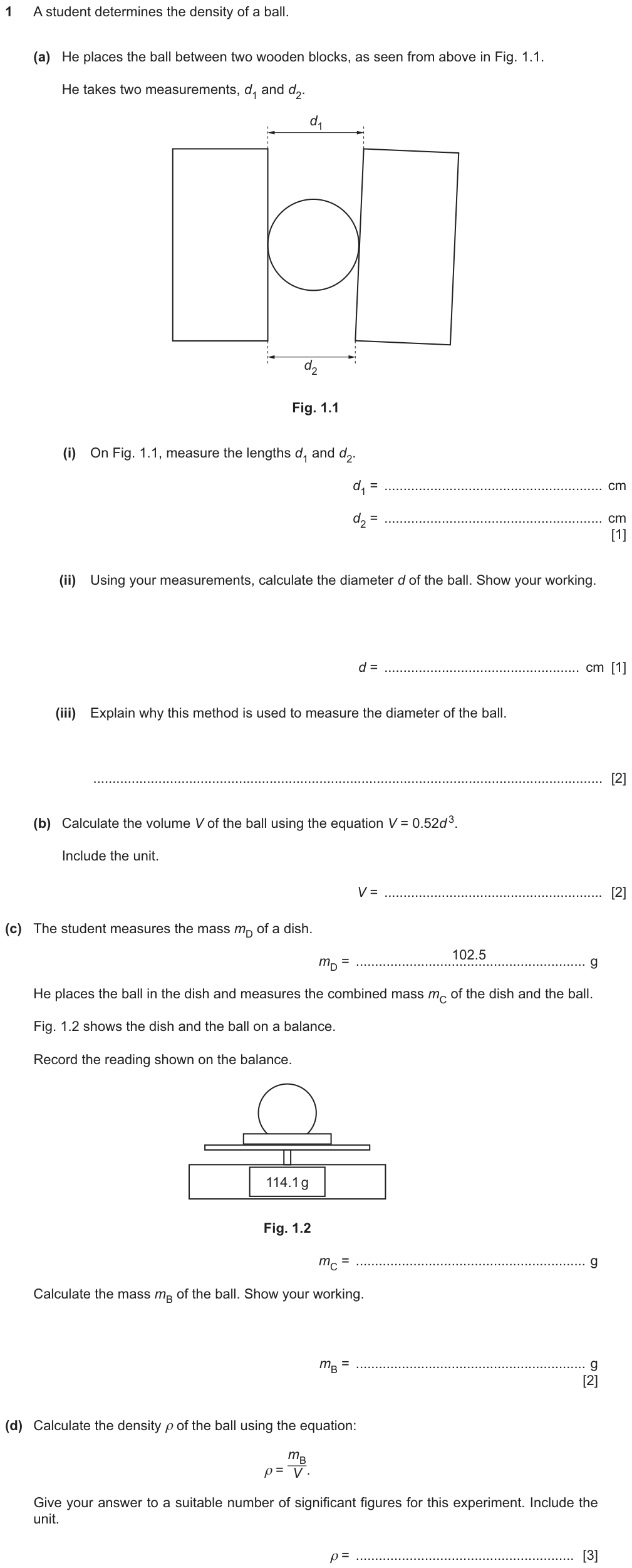
How to start: On the printed paper you measure d1 and d2 with your ruler (they are 2.7 cm and 2.5 cm). Every later part uses those two numbers, so take them carefully to the nearest mm.
✓ Show the answer have a go on paper first
- (a)(i) \(d_1=2.7\) cm and \(d_2=2.5\) cm: lengths on the page, to the nearest mm.
- (a)(ii) The blocks are not quite parallel, so take the average: \(d=\dfrac{2.7+2.5}{2}=2.6\) cm.
- (a)(iii) A ruler held against a ball meets it at one point: it is hard to find the widest part (the centre), and reading the ruler across a curved surface gives a parallax error. The blocks turn the diameter into a gap between two flat faces you can measure.
- (b) \(V=0.52\times2.6^3=9.14\) - the unit is cm³ (d is in cm, cubed).
- (c) \(m_C=114.1\) g (read the display). \(m_B=114.1-102.5=11.6\) g.
- (d) \(\rho=\dfrac{11.6}{9.14}=1.27\) g/cm³. The readings have 2 or 3 significant figures, so 1.3 or 1.27 g/cm³.
| Part | Answer / working | Marks | Guidance |
|---|---|---|---|
| (a)(i) | 2.7 cm and 2.5 cm, both to the nearest mm | B1 | |
| (a)(ii) | correct average, 2.6 cm | B1 | |
| (a)(iii) | difficult to measure the diameter directly / hard to find the centre of the ball | B1 | or any reasonable advantage of the blocks |
| a ruler used directly would give parallax errors | B1 | ||
| (b) | V = 9.1(4) | B1 | |
| unit cm³ | B1 | ||
| (c) | correct method for mB shown (114.1 − 102.5) | B1 | |
| mB = 11.6 g | B1 | ||
| (d) | ρ correctly calculated from your values | B1 | |
| unit g/cm³ | B1 | ||
| given to 2 or 3 significant figures | B1 | ||
| Total: 11 marks | |||
Examiner tip Three of the eleven marks are a unit or a number of significant figures. They are the cheapest marks in the paper - never leave them.
Type 1 Record a reading
"Record the reading shown on the balance." (1 mark)
Spot it a diagram of a scale or display.
- Find what one small division is worth.
- Read to the nearest division (or half-division on an analogue scale).
- Write the unit if the answer line has none.
Type 2 Calculate and give the precision
"Give your answer to a suitable number of significant figures for this experiment. Include the unit." (3 marks)
Spot it 'suitable number of significant figures', 'include the unit'.
- Use the formula given in the question.
- Show the substitution.
- Round to 2 or 3 s.f. (match the readings).
- Write the unit.
Type 3 Explain a technique
"Explain why this method is used…" (2 marks)
Spot it 'explain why', 'suggest why'.
- Say what is hard about the obvious way.
- Say how this method gets round it.
Mistakes to avoid
- ✗ "to make it more accurate"✓ say HOW: "timing 20 swings reduces the effect of reaction time"Rote phrases score nothing (5054 Nov 2023 report).
- ✗ 17:76 for a stopwatch showing 17.76✓ 17.76 sA stopwatch display is seconds and hundredths unless it shows minutes.
- ✗ an answer with no unit✓ 9.1 cm³The unit is often a mark of its own.
- ✗ answering from theory✓ answer from the data on the page"The results show…" not "Physics says…"
- ✗ copying the apparatus list into the plan✓ only the extra apparatus you needCopied lists earn nothing (0625 June 2024 report).
Summary
- Paper 6: 1 hour, 40 marks; three experiment questions and a planning question.
- Every paper tests readings, a table, calculations to 2-3 s.f. with units, a graph, a conclusion, an evaluation and a plan.
- Accurate = close to the true value; precise = readings close together; reproducible = same result another way.
- Answer from the experiment on the page, never from theory alone.
If you see …
- "Include the unit"a unit mark is waiting.
- "suitable number of significant figures"2 or 3 s.f.
- "Suggest"a practical step for THIS apparatus.
Practice
Practice: easy, medium, hard
Easy
Show answer
Answer 31.4 s
Show answer
Answer length of the wire
Show answer
Answer precise (not accurate)
Medium
Guide me
What is it asking? a density
What do we know? m and V
Plan divide, 3 s.f., unit
Show working
- \(25.3\div11.0=2.3\)
- 3 s.f.: 2.30 g/cm³
Answer 2.30 g/cm³
Guide me
What is it asking? a reason
What do we know? one swing ≈ 1 s; reaction time ≈ 0.2 s
Plan compare the error with the time measured
Show answer
Answer reaction-time error is shared over 20 swings, so its effect (percentage error) is smaller
Guide me
What is it asking? yes or no, with numbers
What do we know? 10% of the larger value
Plan compare the difference with 10%
Show answer
Answer yes: 10% of 25.0 is 2.5, and the difference is 1.4
Hard
Show working
- \(3.4^3=39.304\)
- \(0.52\times39.304=20.44\)
Answer 20.4 cm³
| Part | Answer / working | Marks | Guidance |
|---|---|---|---|
| \(0.52\times3.4^3\) | M1 | ||
| 20.4 | A1 | ||
| cm³ | B1 | ||
| Total: 3 marks | |||
Show answer
Answer same person, same method, same apparatus = repeatable. Reproducible needs a different method or arrangement: e.g. repeat with the incident ray on the other side of the normal, or with optics pins instead of a ray box.
| Part | Answer / working | Marks | Guidance |
|---|---|---|---|
| repeatable: same method and conditions | B1 | ||
| reproducible: different method / arrangement, e.g. other side of the normal / pins | B1 | ||
| Total: 2 marks | |||
Show working
- 15.6 s is far outside the others: leave it out
- \((12.0+12.2+12.1)/3=12.1\) s
Answer 15.6 s is the anomaly; average 12.1 s
| Part | Answer / working | Marks | Guidance |
|---|---|---|---|
| 15.6 s identified | B1 | ||
| 12.1 s | B1 | ||
| Total: 2 marks | |||
Can I do this?
- I know how Paper 6 is built and how many marks each question carries.
- I can tell accurate from precise, and repeatable from reproducible.
- I can name the independent, dependent and control variables of an experiment.
- I know what record, calculate, explain, suggest and justify each want.
- I have a plan for the hour, with time saved for the planning question.
Anything unticked: revise that section first. All ticked: take the quiz.
Quiz
The multiple-choice and guided questions need JavaScript. The concept checks and exam practice below work without it.
Your progress on this note is saved when JavaScript is on.