
Practical skills: Paper 6 Alternative to Practical
Tables and calculations: headings, units and significant figures
In this note
- AO3Record results systematically in a table: quantity / unit in every heading, units in the headings only.
- AO3Give raw readings to the precision of the instrument, all to the same number of decimal places in a column.
- AO3Give calculated values to 2 or 3 significant figures, consistently.
- AO3Work out the unit of any calculated quantity (°C/s, N/cm, Ω/cm, 1/A, s²).
- AO3Average repeated readings, leaving out an anomaly.
Before you start: measurements and readings.
Rules to learn
Drawing a results table
A results table is where the mark scheme looks first. Draw it with a ruler, one column per quantity, and put the unit in the heading, never in the cells.
General methodHow to draw any results table
- First column: the independent variable (the one the student changes).
- Next: the dependent variable (what is measured); one column per repeat if there are repeats, then the average.
- Last: any calculated column (e.g. R = V/I, 1/I, T²).
- Head every column quantity / unit: length / cm, time for 20 oscillations / s, R / Ω.
- Fill the cells with numbers only, each column to a consistent number of decimal places.
| l / cm | t₁ / s | t₂ / s | average t / s | T / s |
|---|---|---|---|---|
| 20.0 | 18.1 | 18.3 | 18.2 | 0.910 |
| 40.0 | 25.5 | 25.7 | 25.6 | 1.28 |
| 60.0 | 31.2 | 31.0 | 31.1 | 1.56 |
An example of a correct table (our own numbers): the IV first, two repeats, the average, then the calculated period (20 oscillations). Headings are "quantity / unit"; "time (s)" is also accepted, but "time / seconds" or units written in each cell are not good practice.
Try it yourself
Show answer
Answer θ / °C (or temperature / °C)
Show answer
Answer s²
Precision in a column
Raw readings show how precise the instrument is. If a ruler reads to the nearest mm, every length in the column is written to 0.1 cm: 5.0, 10.0, 15.0 cm - not 5, 10, 15. The mark scheme gives a mark for this "consistency".
| Column | Wrong | Right |
|---|---|---|
| lengths (mm ruler) | 5, 10.0, 15.25 cm | 5.0, 10.0, 15.3 cm |
| temperatures (1 °C scale) | 80, 74.5, 69, 65.5 | 80.0, 74.5, 69.0, 65.5 °C |
| calculated 1/I | 5.714285, 5, 4.35 | 5.71, 5.00, 4.35 |
Significant figures
A calculated answer cannot be more precise than the readings it came from. In this paper that almost always means 2 or 3 significant figures. The scheme often says "2 or 3 s.f." or "consistent 2 or consistent 3 s.f.": all answers of the same kind to the same number.
General methodHow to give a calculated answer
- Do the whole calculation with every figure on the calculator (don't round in the middle).
- Count the significant figures in the readings you used (start from the first non-zero digit: 0.0350 has 3).
- Round the answer to that number - usually 2 or 3 s.f.
- Write the unit.
| Calculator shows | 2 s.f. | 3 s.f. |
|---|---|---|
| 2.333333 | 2.3 | 2.33 |
| 0.0749 | 0.075 | 0.0749 |
| 15.5589 | 16 | 15.6 |
| 3.6481 | 3.6 | 3.65 |
| 1257.8 | 1300 | 1260 |
| 0.685 | 0.69 | 0.685 |
Example V = 1.50 V and I = 0.42 A. Calculate R and give it to a suitable number of significant figures.
The readings have 3 and 2 s.f., so give 2 or 3 s.f.
- \(R=\dfrac{V}{I}=\dfrac{1.50}{0.42}=3.5714\ldots\)
- \(R=3.57\ \Omega\) (or 3.6 Ω)
Answer 3.57 Ω
Try it yourself
Show answer
Answer 0.075
Show answer
Answer 0.40
Show answer
Answer 3
Units of calculated quantities
The unit of a calculated quantity comes from the calculation: do the same thing to the units as to the numbers. A gradient's unit is the y-axis unit divided by the x-axis unit.
| Calculation | Unit |
|---|---|
| rate of cooling = temperature change ÷ time | °C/s (or °C/min) |
| spring constant k = load ÷ extension | N/cm or N/m |
| resistance per unit length = R ÷ l | Ω/cm |
| 1/I | 1/A (A⁻¹) |
| \(T^2\) | s² |
| density = mass ÷ volume | g/cm³ |
| gradient of θ against t | °C/s |
| speed = distance ÷ time | cm/s or m/s |
Example Water cools by 18.0 °C in 240 s. Average rate of cooling?
Temperature change ÷ time, unit °C/s.
- \(18.0\div240=0.075\)
Answer 0.075 °C/s
Try it yourself
Show answer
Answer 0.40 N/cm
Show answer
Answer A/V
Averages and repeats
Repeating a reading and averaging reduces the effect of random errors. Before you average, look for an anomaly: a value well outside the others. Leave it out (or repeat it), and say so.
Example Three timings: 21.4 s, 21.8 s, 21.6 s. Average?
Add, divide by 3, give to 0.1 s like the readings.
- \((21.4+21.8+21.6)\div3=21.6\) s
Answer 21.6 s
Try it yourself
Show answer
Answer 5.3 cm
From the past papers
Past paper 1
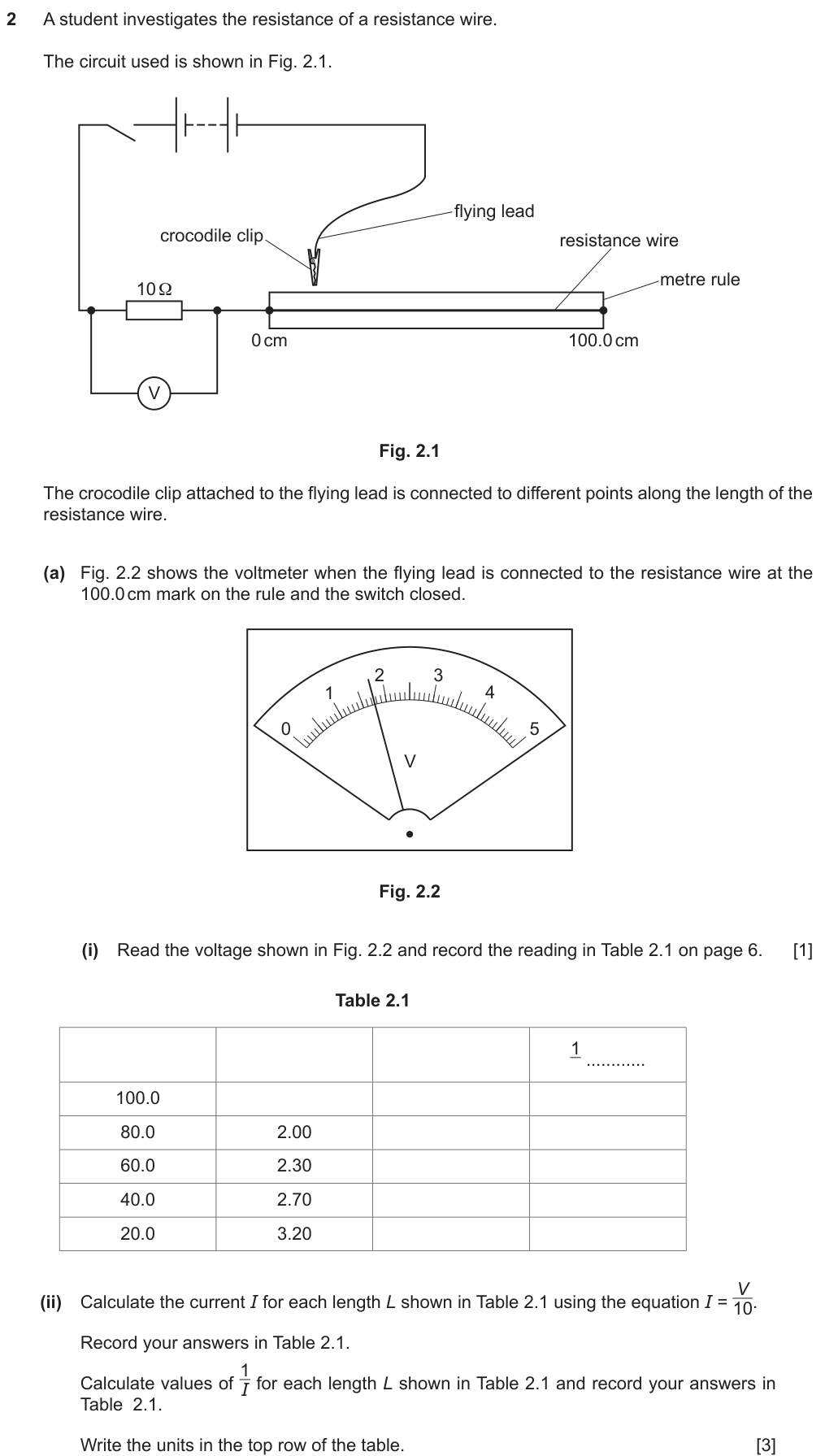
How to start: Read the voltmeter first: labels 0 to 5 V, count the small divisions between 1 and 2. Then the table is three jobs: the I column, the 1/I column, and the headings with units.
✓ Show the answer have a go on paper first
- (a)(i) There are 10 small divisions between labelled volts, so one division = 0.1 V. The needle is halfway between 1.7 and 1.8: read to the half-division, \(V=1.75\) V.
- (a)(ii) \(I=V/10\): 0.175, 0.200, 0.230, 0.270, 0.320 A.
- \(1/I\): 5.71, 5.00, 4.35, 3.70, 3.13 - all to 2 d.p. (consistent).
- Headings: L / cm · V / V · I / A · \(\tfrac{1}{I}\) / 1/A.
| Part | Answer / working | Marks | Guidance |
|---|---|---|---|
| (a)(i) | 1.75 (V) | B1 | |
| (a)(ii) | values of I and 1/I calculated correctly | B1 | |
| consistency: all values of 1/I recorded to 2 or 3 d.p. | B1 | ||
| column headings with correct units | B1 | 1/I in 1/A or A⁻¹ | |
| Total: 4 marks | |||
Examiner tip Two of the three marks in (a)(ii) are not for physics: they are for writing the column consistently and giving units in the headings.
Units in a results table
Calculate the current I for each length L … Calculate values of 1/I … Write the units in the top row of the table.
- L / cm, V / V, I / A, 1/I / 1/A (or A⁻¹)
- units in the HEADINGS of every column
- units written next to each number in the cells
- 1/I / A (the unit of I, not of 1/I)
- a heading with no unit
The quantity in the column is 1/I, so its unit is 1 ÷ (unit of I) = 1/A. The report says many candidates ignored or got the headings wrong and that 1/A caused difficulty.
From: 5054/41/O/N/23 Q2(a)(ii) scheme and examiner report
Type 1 Complete the table
"Calculate … and record your answers in Table 2.1." (2-3 marks)
Spot it a table with blank cells or columns.
- Calculate every blank cell.
- Same number of d.p. down each column.
- Units in the heading if asked.
Type 2 Draw a table
"Draw a table to record…" (planning question, 1 mark)
Spot it planning question.
- IV column, DV column (with repeats), calculated column.
- quantity / unit headings.
Type 3 Calculate with s.f.
"Give your answer to a suitable number of significant figures for this experiment."
Spot it "suitable number of significant figures".
- Full calculation.
- Round to 2 or 3 s.f.
- Unit.
Type 4 Choose the better value
"Which value is more suitable … ? Explain." (1 mark)
Spot it two answers, one too precise.
- Pick the one written to the precision of the apparatus.
- Say why: the readings are only to 2 or 3 s.f.
Mistakes to avoid
- ✗ time (seconds) in one cell, 12.3 s in another✓ time / s in the heading, numbers in the cells
- ✗ 5, 10.0, 15.25✓ 5.0, 10.0, 15.3 (same d.p.)Consistency is a mark.
- ✗ 2.333333 Ω✓ 2.33 Ω (or 2.3 Ω)Too many figures is wrong, not extra-good.
- ✗ 1/I / A✓ 1/I / 1/AReciprocal quantity, reciprocal unit.
- ✗ rounding halfway through the calculation✓ round only the final answerEarly rounding can shift the last figure.
- ✗ 1/3 as an answer✓ 0.33Fractions are not accepted.
Summary
- Headings: quantity / unit. Units never in the cells.
- Order: IV, DV (repeats, average), calculated columns.
- Raw readings: the instrument's precision, same d.p. down a column.
- Calculated values: 2 or 3 s.f., consistently, with the unit.
- Derived units follow the calculation: °C/s, N/cm, Ω/cm, 1/A, s².
If you see …
- "Write the units in the top row"quantity / unit for every column.
- "suitable number of s.f."2 or 3.
- a reciprocal (1/x)reciprocal unit.
Practice
Practice: easy, medium, hard
Easy
Show answer
Answer 15.6
Show answer
Answer 30.4 s
Show answer
Answer g/cm³
Medium
Guide me
What is it asking? same d.p.
What do we know? nearest mm = 0.1 cm
Plan one d.p. each
Show answer
Answer 4.0, 8.5, 12.3, 16.0 cm
Guide me
What is it asking? R
What do we know? V and I
Plan V ÷ I
Show working
- \(1.8\div0.24=7.5\)
Answer 7.5 Ω
Guide me
What is it asking? a rate
What do we know? change and time
Plan change ÷ time
Show working
- 18.0 ÷ 5.0 = 3.6
Answer 3.6 °C/min
Hard
Show answer
Answer 5.71, 4.00, 2.50; heading 1/I / 1/A
| Part | Answer / working | Marks | Guidance |
|---|---|---|---|
| 5.71, 4.00, 2.50 | B1 | ||
| all to 2 d.p. | B1 | ||
| 1/I / 1/A | B1 | ||
| Total: 3 marks | |||
Show answer
Answer 1.3 s: the timings are only to 0.1 s (2-3 s.f.), so 1.2965 s claims a precision the readings do not have
| Part | Answer / working | Marks | Guidance |
|---|---|---|---|
| 1.3 s | B1 | ||
| reference to the precision of the readings / apparatus | B1 | ||
| Total: 2 marks | |||
Show working
- 3.0 ÷ 7.5 = 0.40
Answer 0.40 N/cm
| Part | Answer / working | Marks | Guidance |
|---|---|---|---|
| 0.40 | B1 | ||
| N/cm | B1 | ||
| Total: 2 marks | |||
Can I do this?
- I draw tables with IV first and quantity / unit headings.
- I write each column of readings to the same number of decimal places.
- I give calculated answers to 2 or 3 s.f., consistently.
- I can work out the unit of any calculated quantity, including 1/x and x².
- I average repeats and leave out anomalies.
Anything unticked: revise that section first. All ticked: take the quiz.
Quiz
The multiple-choice and guided questions need JavaScript. The concept checks and exam practice below work without it.
Your progress on this note is saved when JavaScript is on.