
Practical skills: Paper 6 Alternative to Practical
Thermal experiments: cooling, heating and temperature
In this note
- AO3Read a thermometer correctly and know the techniques that make the reading accurate (stir, wait, eye level).
- AO3Record a cooling or heating experiment at fixed times and draw the curve.
- AO3Calculate an average rate of cooling (°C/s) and explain why it changes.
- AO3Make a cooling or heating comparison a fair test and suggest how to reduce energy losses.
- AO3Use heating data to find a specific heat capacity, and handle melting, evaporation and mixing experiments.
The skills used here: readings, graphs, fair tests.
Rules to learn
Reading a thermometer
School thermometers run from −10 °C to 110 °C with 1 °C marks. Read to the nearest half-degree, at the top of the liquid thread.
| Technique | Why |
|---|---|
| eye level with the top of the liquid, line of sight perpendicular to the scale | no parallax |
| stir the water before each reading | the temperature is the same throughout the water |
| wait until the reading stops changing (at the start) | the thermometer takes time to reach the water's temperature |
| bulb fully in the water, not touching the beaker | you measure the water, not the glass |
| thermometer held in a clamp | it doesn't touch the sides and the scale can face you |
Try it yourself
Show answer
Answer 67.5 °C
Cooling curves
Hot water is poured into a beaker and its temperature read every 30 s (or every minute). The temperature falls quickly at first, then more slowly as it gets close to room temperature: the hotter the water compared with the room, the faster it loses energy.
General methodHow to take readings at exact times
- Start the stopwatch as you take the first reading and let it run (don't stop it).
- Keep the stopwatch next to the thermometer, or have one person call the time and one read the thermometer.
- Stir just before each reading; read at eye level.
Example Water cools from 80.0 °C to 62.0 °C in 300 s. Average rate of cooling?
Fall ÷ time, unit °C/s.
- \(\Delta\theta=80.0-62.0=18.0\) °C
- \(18.0\div300=0.060\) °C/s
Answer 0.060 °C/s
Comparing the first and second halves of a cooling run always gives a bigger rate first. That is why a fair comparison of two containers needs the SAME starting temperature.
Try it yourself
Show answer
Answer 0.075 °C/s
Fair tests for heating and cooling
| Investigation | Change | Keep the same |
|---|---|---|
| effect of insulation / a lid | insulated or not; number of layers | volume of water, starting temperature, beaker, time, room temperature |
| effect of surface colour (radiation) | colour of the container or card (black, white, shiny) | distance from the lamp, lamp power, volume and starting temperature, time |
| effect of surface area (evaporation) | area of the dish | volume of water, starting temperature, time, no draughts |
| effect of volume | volume of water | starting temperature, beaker, time |
| Reduce energy lost to the surroundings by… | Because |
|---|---|
| insulating the beaker (cotton wool, foam) | less conduction through the sides |
| a lid | less evaporation and convection from the surface |
| shielding from draughts | less convection |
| a shiny or white outer surface | less radiation |
Heating, specific heat capacity and changes of state
An electric heater in a block or in water supplies energy \(E=VIt\). Measure the temperature rise and the mass to find the specific heat capacity \(c=\dfrac{E}{m\Delta\theta}\).
Example A 12.0 V heater draws 2.0 A for 300 s and heats 0.200 kg of water from 28.0 °C to 36.5 °C. Specific heat capacity?
Energy in, then c = E / (m Δθ).
- \(E=12.0\times2.0\times300=7200\) J
- \(\Delta\theta=36.5-28.0=8.5\) °C
- \(c=\dfrac{7200}{0.200\times8.5}=4235\) J/(kg °C) \(\approx4200\) J/(kg °C)
Answer about 4200 J/(kg °C)
| Experiment | Typical answer the scheme looks for |
|---|---|
| why the value of c is higher than the true value | energy is lost to the surroundings, so more energy seemed to be needed |
| improve it | insulate the container; lid; stir |
| melting ice in different conditions | same mass of ice, same starting size/shape, time until fully melted |
| mixing hot and cold water | measure both starting temperatures and the final one; stir; insulate |
| evaporation | measure the mass (or volume) lost over a fixed time; same starting temperature and volume |
Try it yourself
Show answer
Answer 12.0 °C
From the past papers
Past paper 1
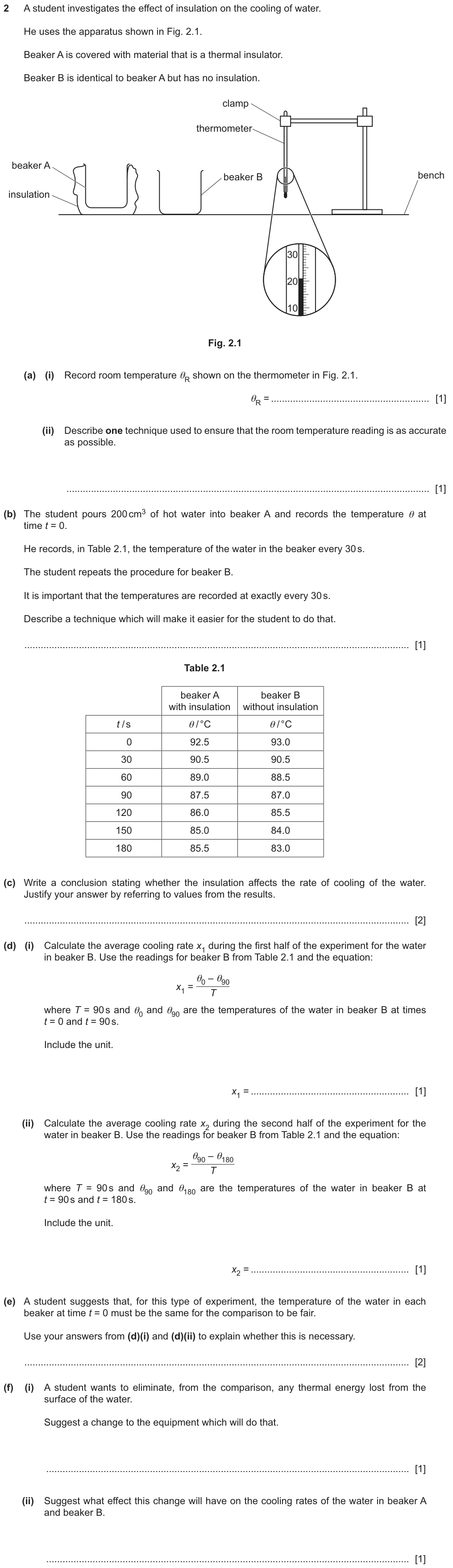
How to start: Look at the falls over the whole 180 s (A: 7.0 °C, B: 10.0 °C) before you write the conclusion, and use exactly the times the question names for the rates.
✓ Show the answer have a go on paper first
- (a)(i) \(\theta_R=21\) °C. (ii) Read the scale with the eye perpendicular to it (level with the top of the liquid).
- (b) Keep the stopwatch next to the thermometer and let it run, or have one student watch the timer and call out every 30 s while the other reads.
- (c) Beaker A (insulated) cools more slowly: over 180 s A falls 7.0 °C (92.5 → 85.5) but B falls 10.0 °C (93.0 → 83.0).
- (d)(i) \(x_1=\dfrac{93.0-87.0}{90}=0.067\) °C/s. (ii) \(x_2=\dfrac{87.0-83.0}{90}=0.044\) °C/s.
- (e) \(x_1>x_2\): the water cools faster when it is hotter. So the starting temperature affects the cooling rate: both beakers must start at the same temperature, so the comparison depends only on the insulation.
- (f)(i) Put a lid on both beakers (or insulate all over both). (ii) Both cooling rates decrease.
| Part | Answer / working | Marks | Guidance |
|---|---|---|---|
| (a)(i) | 21 (°C) | B1 | |
| (a)(ii) | read the scale perpendicularly | B1 | |
| (b) | how to take the reading at a precise time, e.g. stopwatch and thermometer close together / timer set for every 30 s / one student watches the timer and another reads the thermometer | B1 | |
| (c) | beaker A / the insulated beaker cools more slowly | B1 | |
| comparison of the temperature changes over 180 s, matching the statement (values used) | B1 | ||
| (d)(i) | x₁ = 0.067 and x₂ = 0.044 | B1 | |
| (d)(ii) | unit °C/s | B1 | |
| (e) | comparison of x₁ and x₂ | B1 | |
| yes: A and B must start at the same temperature so the comparison depends only on the insulation | B1 | ||
| (f)(i) | add lids to both beakers / insulation all over both / cover both | B1 | |
| (f)(ii) | cooling rates decrease | B1 | |
| Total: 11 marks | |||
Examiner tip In (c) the scheme needs NUMBERS from the table, from the same time span for both beakers.
Explaining why you stir / wait
The student lowers a thermometer into 200 cm³ of hot water and waits for approximately 30 s before starting a stop-watch. Explain why the student waits for 30 s before reading the initial temperature of the hot water.
- to allow the thermometer to reach the temperature of the water
- to give the thermometer liquid time to expand
- "to make it accurate"
- "so the water cools"
- "to avoid parallax"
Rote phrases do not say what the waiting achieves. The thermometer starts at room temperature; its liquid needs time to warm to the water's temperature before the reading is the water's.
From: 5054/42/O/N/23 Q2(a)(ii) scheme ("to allow thermometer to reach the temperature of the hot water / to allow thermometer to respond")
Type 1 Rate of cooling
"Calculate the average cooling rate … Include the unit." (1-2 marks)
Spot it two temperatures and a time.
- Fall in temperature.
- ÷ time.
- °C/s or °C/min.
Type 2 Conclusion from two containers
"Write a conclusion … Justify by referring to values." (2 marks)
Spot it two columns of temperatures.
- Which cools more slowly.
- Quote the falls over the SAME time.
Type 3 Fair test
"State two variables that should be kept constant." (2 marks)
Spot it a comparison.
- Volume, starting temperature, beaker, room temperature, time.
Type 4 Reduce energy loss
"Suggest a change to the equipment …" (1 mark)
Spot it "heat loss", "thermal energy lost".
- Lid / insulation / shield from draughts.
Mistakes to avoid
- ✗ comparing falls over different times✓ the same time span for both
- ✗ rate with no unit✓ °C/sThe unit is a mark.
- ✗ "reduce heat loss"✓ "put a lid on the beaker"Name the change.
- ✗ "same amount"✓ "same volume of water"Be exact.
- ✗ joining cooling points with straight lines✓ one smooth curve
Summary
- Thermometer: eye level, stir, wait for the reading to settle, bulb in the water.
- Cooling is fastest at first; rate = fall ÷ time (°C/s).
- Fair comparison: same volume, starting temperature, container, time and room.
- Less energy loss: lid, insulation, no draughts, shiny surface.
- c = E / (m Δθ) with E = VIt.
If you see …
- "cooling rate"Δθ ÷ Δt with °C/s.
- "fair"same starting temperature and volume.
- "lost from the surface"a lid.
Practice
Practice: easy, medium, hard
Easy
Show answer
Answer 3.0 °C/min
Show answer
Answer so the temperature is the same throughout the water
Show answer
Answer 1800 J
Medium
Guide me
What is it asking? which, with numbers
What do we know? falls over the same time
Plan smaller fall = better insulated
Show answer
Answer P: it fell 5.5 °C, Q fell 9.0 °C in the same time
Guide me
What is it asking? c
What do we know? E, m, Δθ
Plan c = E/(mΔθ)
Show working
- 6300 ÷ (0.250 × 6.0)
Answer 4200 J/(kg °C)
Guide me
What is it asking? two controls
What do we know? what else affects cooling?
Plan amount and starting temperature
Show answer
Answer volume of water; starting temperature (also same can size, time, room temperature)
Hard
Show answer
Answer 0.060 and 0.050 °C/s; it cools more slowly as its temperature gets closer to room temperature
| Part | Answer / working | Marks | Guidance |
|---|---|---|---|
| 0.060 °C/s | B1 | ||
| 0.050 °C/s | B1 | ||
| rate falls as the temperature difference with the room falls | B1 | ||
| Total: 3 marks | |||
Show answer
Answer energy is lost to the surroundings, so more energy appears to be needed per kg per °C; insulate the beaker / add a lid
| Part | Answer / working | Marks | Guidance |
|---|---|---|---|
| energy lost to the surroundings | B1 | ||
| insulation / lid | B1 | ||
| Total: 2 marks | |||
Can I do this?
- I can read a thermometer and give techniques for an accurate reading.
- I can calculate a rate of cooling and explain why it slows down.
- I can make heating and cooling comparisons fair and reduce energy losses.
- I can find a specific heat capacity from heating data and explain why it comes out high.
Anything unticked: revise that section first. All ticked: take the quiz.
Quiz
The multiple-choice and guided questions need JavaScript. The concept checks and exam practice below work without it.
Your progress on this note is saved when JavaScript is on.